16 April 2007

Was ich schon immer über 'Rodent Arousal' wissen wollte, aber nie zu fragen gewagt habe.

Heh. Manchmal ist das Lesen von Wissenschaftsseiten auch witzig. In einem Artikel über Viagra für Frauen ('The Search for the Female Equivalent of Viagra', NYTimes; frei nach Registrierung) fand ich folgendes:
More recently, another potentially promising treatment for hypoactive desire has been making its way through clinical trials. The compound, called bremelanotide, is a synthetic version of a hormone involved in skin pigmentation, and it was initially developed by Palatin Technologies of New Jersey as a potential tanning agent to help prevent skin cancer. But when male college students participating in early safety tests began reporting that the drug sometimes gave them erections, the company began exploring bremelanotide’s utility as a treatment for sexual disorders.

Studies in rodents demonstrated that the drug not only gave male rats spontaneous erections, but also fomented sexual excitement in female rats, prompting them to wiggle their ears, hop excitedly, rub noses with males and otherwise display unmistakable hallmarks of rodent arousal.
Ich habe dabei Bilder von aufgeregt herumhüpfenden Frauen vor Augen, mit diskret zuckenden Ohren, ich kann's nicht verhindern. Möglicherweise sind auch noch alle gut gebräunt...

MfG,
JLT

Weiterlesen...

Was Kreationisten alles schon wissen...

Als kleiner Nachtrag zu meinem Post vom Samstag (Dino McNuggets):

For the moment, let’s not ignore the importance of what has been found (and as will be declared in the soon-to-open Creation Museum): finding T. rex soft tissue is compelling evidence that it was not 65 million years ago that dinosaurs died out, as given on the evolutionary timeline. Furthermore, if dinosaurs have been roaming the earth in relatively recent times, there would have been virtually no time, for example, for the supposed evolution of reptilian scales into intricate feathers.

Indeed, this T. rex fossil provides wonderful circumstantial evidence to support the biblical chronology of a young earth. Additionally, creationists already know that birds were created before dinosaurs: on days 5 and 6 respectively of creation week.
[Quelle: Answers in Genesis]

Jau, genau. Und die Pflanzen vor den Meerestieren....

Um trotz allem bei einer wissenschaftlichen Terminologie zu bleiben: Es ist jenseits vernünftigen Zweifels belegt, dass erst die Dinosaurier und dann die Vögel entstanden sind.
Wer trotz der Masse der Hinweise auf das Gegenteil trotzdem Behauptungen wie die hervorgehobene aufstellt (und sie auch noch glaubt), lebt in einem illusorischen Paralleluniversum, das mit der Realität nichts, aber auch gar nichts zu tun hat.

Die Seite von AiG, über den ich auch den oben zitierten Ausschnitt gefunden habe, kommentiert neue wissenschaftlichen Veröffentlichungen. Weiter unter findet sich dies:
Stunning examples of God’s awesome capacity for design abound all around us—even in the lowly spider! Research published recently in Biology Letters explains how spiders take to the air, “flying” by “casting out a ‘dragline’ of silk thread, which gets carried by the wind, along with the attached critter.” But the truly amazing aspect of spider flight, as reported in the research, is how spiders determine “the best flight weather” before casting their lines. Spiders are most likely to “soar” on cloudy fall and spring days, avoiding breezeless summer days as well as the other extreme, stormy and wintry conditions.

This is where the design aspect comes in; after all, spiders lack the tools available to meteorologists! But as lead study author Andy Reynolds explains, “The literature on spider sensing points to tarsal organs and hairs as having roles in, respectively, the detection of temperature and wind speed.” While evolutionists wonder how such an integrated weather-determining system would have evolved, creationists can recognize the wonderful mechanism as part of God’s design.
Mal abgesehen von allem anderen, zeigt dieser Abschnitt eins ganz deutlich. ID-Kreationismus führt in ein intellektuelles Vakuum. Sie sagen es selbst: Während Wissenschaftler untersuchen, wie sich ein solches System entwickelt haben könnte (und überhaupt erst entdeckt haben, dass es dieses System gibt), stellen sich Kreationisten hin, sagen "Toll!" und "Goddidit." (wahrscheinlich mit glasigem Blick) und das war's.

Wenn's nach ihnen ginge, gäbe es keine (weitere) Forschung. Kreationismus ist das Ende von Wissenschaft.

MfG,
JLT

[Bild-Quelle: BBC News]

Weiterlesen...

14 April 2007

Dino McNuggets

Noch ein kleiner Newsflash:


Aus einem Dinosaurierknochen haben Wissenschaftler Protein extrahieren und dessen Zusammensetzung mittels Massenspektrometrie bestimmt können.
The findings of protein in the bones were confirmed by mass spectrometry, a sensitive technique that identifies chemicals by their atomic mass.

It was able to show the T. rex material contained sequences of amino acids - protein building blocks - typical of collagen.[...]

When the scientists compared the protein sequence pattern to those of living animals in a database, it was found to be structurally similar to chicken collagen, and there were also similarities with frog and newt protein.
[Quelle und Bild-Quelle: BBC News]

Das die Proteinzusammensetzung des Dino-Kollagens der des Hühner-Kollagens sehr ähnlich ist, entspricht natürlich genau dem, was man erwarten würde - wenn man denn die Evolutionstheorie akzeptiert.

MfG,
JLT


Asara et al., Protein Sequences from Mastodon and Tyrannosaurus Rex Revealed by Mass Spectrometry. Science 13 April 2007: Vol. 316. no. 5822, pp. 280 - 285
Schweitzer et al., Analyses of Soft Tissue from Tyrannosaurus rex Suggest the Presence of Protein. Science 13 April 2007: Vol. 316. no. 5822, pp. 277 - 280

Weiterlesen...

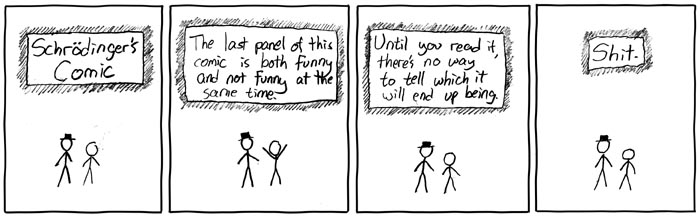
Aufgabe für's Wochenende: Quantenmechanik verstehen.

Ok, ich bin nun mal ein Nerd...

Für alle, die dies auch witzig finden:

xkcd - A webcomic of romance, sarcasm, math, and language.

Schönes Wochenende!
JLT

P.S.: Ich werde eins haben, hoffentlich. Das Wetter ist immer noch gut, also geht's wieder "auf's Land".


Weiterlesen...

13 April 2007

Aller Guten Dinge sind (mindestens) Drei.

Das Makaken-Genom ist vollständig sequenziert und wurde heute in Science veröffentlicht. Damit ist der dritte Primat (nach Mensch und Schimpanse) vollständig sequenziert. Science hat eine Online Collection zum Thema, dazu gehört z. B. auch ein Interaktives Poster mit den wichtigsten Infos (sollte frei erhältlich sein).

Ich werde später noch etwas ausführlicher dazu schreiben, momentan bin ich eher nicht in Stimmung. Das Forscherleben ist schon hart, manchmal... werde aber nicht mit Details langweilen.

MfG,
JLT

[Bild-Quelle: Wikipedia]

P.S.: Wer's nicht abwarten kann, hier und hier sind zwei relativ ausführliche deutsche Artikel, die darüber berichten.

Weiterlesen...

Das Mittel, um gleichzeitig schlank zu bleiben und reich zu werden.

"Ich brauche ein Stück Kuchen nur ansehen und schon nehme ich zu".
Wie oft ich dies oder Varianten davon schon von anderen Frauen gehört habe, wage ich nicht zu schätzen. Meist (da ich selbst keine Gewichtsprobleme habe) in Zusammenhang mit: "Du hast Glück, Du nimmst nicht so leicht zu". Was ich dazu gedacht habe, war manchmal nicht sonderlich freundlich, denn so ganz zufällig sind meine mangelnden Gewichtsprobleme dann auch wieder nicht.

Jetzt stellt sich raus, dass zumindestens ein wenig Glück (oder Pech) doch daran beteiligt ist. In einer neuen Studie, veröffentlicht in der neuen Science-Ausgabe (Frayling et al., A Common Variant in the FTO Gene Is Associated with Body Mass Index and Predisposes to Childhood and Adult Obesity. Published Online April 12, 2007. Science DOI: 10.1126/science.1141634), wurde ein Zusammenhang zwischen einer weit verbreiteten Variante eines Gens namens FTO und Übergewicht festgestellt. Die Autoren suchten nach dieser FTO-Variante in der DNA von fast 40.000 Menschen und ihre Ergebnisse waren eindeutig.
The 16% of adults who are homozygous for the risk allele weighed about 3 kilograms more and had a 1.67-fold increased risk of obesity when compared with those not inheriting a risk allele. This association was observed from age 7 years upward and reflects a specific increase in fat mass.
Jetzt müssen sie nur noch rausfinden, was FTO eigentlich macht.
The researchers don't know what FTO does. But because FTO may lead to a new pathway for controlling weight, "we'll have people racing to understand" the gene's function, says obesity researcher Jeffrey Flier of Harvard Medical School in Boston. Those studies should help unravel the basic biology of obesity.
[Quelle: Kaiser J, GENETICS: Mysterious, Widespread Obesity Gene Found Through Diabetes Study. Science 13 April 2007: Vol. 316. no. 5822, p. 185]

Ha, will jemand reich werden? Erforsche die Funktion dieses Gens und finde einen Weg, wie diese Funktion medikamentös zu beeinflussen ist - Viagra ist mit Sicherheit ein kommerzieller Erfolg, aber im Vergleich zu einem solchen Mittel würde es sich ausnehmen wie der Verkaufserfolg von Mensch-Ärger-Dich-Nicht-Spielen im Vergleich zu dem der PS3 Ende März 2007.

MfG,
JLT

Weiterlesen...

12 April 2007

Kleine außerirdische Farbenlehre, nur für den Fall...

Mit den heutigen Möglichkeiten ist die direkte Beobachtung extrasolarer (außerhalb unseres Sonnensystems befindlicher), "erdähnlicher" Planeten im Orbit um sonnenähnliche Sterne ausgeschlossen, da das von ihnen reflektierte Licht von dem der Lichtquelle (des Sterns) bei weitem überstrahlt wird. In einem Artikel in der aktuellen Nature-Ausgabe wird ein Teleskop-Modell vorgestellt, das diese technische Schwierigkeit überwinden könnte.
The detection and characterization of an Earth-like planet orbiting a nearby star requires a telescope with an extraordinarily large contrast at small angular separations. At visible wavelengths, an Earth-like planet would be 1 times 10-10 times fainter than the star at angular separations of typically 0.1 arcsecond or less. There are several proposed space telescope systems that could, in principle, achieve this. Here we report a laboratory experiment that reaches these limits. We have suppressed the diffracted and scattered light near a star-like source to a level of 6 times 10-10 times the peak intensity in individual coronagraph images. In a series of such images, together with simple image processing, we have effectively reduced this to a residual noise level of about 0.1 times 10-10. This demonstrates that a coronagraphic telescope in space could detect and spectroscopically characterize nearby exoplanetary systems, with the sensitivity to image an 'Earth-twin' orbiting a nearby star.
[Quelle: Trauger JT & Traub WA. A laboratory demonstration of the capability to image an Earth-like extrasolar planet. Nature 446, 771-773 (12 April 2007)]

Von daher machen auch Überlegungen wie die folgende einen Sinn: Wie würden Photosynthese-betreibende "Pflanzen" auf anderen Planeten aussehen?
Nancy Kiang*, a biometeorologist at the NASA Goddard Institute for Space Studies in New York, modelled the solar and atmospheric conditions of other planets to see which ones might be suitable for photosynthetic life, and what those photosynthesizers might look like.

Red dwarfs, for example, emit only a fraction of the visible light produced by our own Sun, meaning that plants on planets around these stars will probably hoard all the visible light they can absorb, rather than reflecting back any particular wavelength, Kiang hypothesizes. That means they would probably look black.

[...]Earth already provides a variety of colours and pigments to chose from — from the comforting greens of our land plants to the dull purples of some photosynthetic bacteria, and the jarring reds of certain seaweeds.

The colour reflected by each of these organisms is made up of the wavelengths that the photosynthesizer has shunned — typically those that are not particularly useful for them. The colour of a plant, therefore, can depend on the quality of light the plant receives and that, in turn, depends on the properties of the local sun and the atmosphere that filters out the sun's rays.

The sunlight that strikes Earth's surface, for example, is rich in green light, but land plants often shun this seemingly rich source of energy. [...] But green light is not as rich in photons as red light and not as energetic as blue light. So although plants seem to have wasted energy by not harnessing the abundant greens, Kiang thinks that they've just focused their efforts on the more nutritious reds and blues.

The team thinks that all plants will be keen to suck up high-energy blue light — so that rules out bright blue leaves.[...]

Telescopes can't yet see the colours of far-flung rocky planets, but the team hopes that their work can be used to design instruments that can detect the spectral signatures characteristic of photosynthetic life. Their model helps to show which wavelengths plants on various planets would be most likely to absorb, creating a custom signature for life for different planetary situations.
[Quelle & Bild-Quelle: Ledford. Alien plants may come in all colours but blue. News@Nature]

Was ist eigentlich die kreationistische Einstellung zu außerirdischem Leben?

Wobei, wenn morgen veröffentlicht würde, dass Leben auf einem anderen Planeten gefunden wurde, gäbe es wohl auch nur die üblichen Reaktionen: Leugnen, Goddidit und/oder Freie Assoziation von Bibelstellen, bis eine gefunden ist, die man so interpretieren könnte, als wäre das mit dem außerirdischen Leben dem Autor schon bekannt gewesen....

MfG,
JLT


* Kiang N. Y., et al. Spectral signatures of photosynthesis. I. Review of Earth organisms. Astrobiology, 7 . 222 - 251 (2007).
Kiang N. Y., et al. Spectral Signatures of Photosynthesis. II. Coevolution with Other Stars And The Atmosphere on Extrasolar Worlds.
Astrobiology, 7 . 252 - 274 (2007).

Weiterlesen...

Etwas Philosophiererei zum noch nicht ganz Wochenende.

Wir leben auf einem Planeten, der einen der ca. 1011 Sterne unserer Galaxis umkreist. Auch diese unsere Galaxie ist nur eine von vielen. Man schätzt, dass mit heutiger Technik etwa 5 x 10⁵ Galaxien allein von der Erde aus beobachtet werden können. Insgesamt soll es im sichtbaren Universum 7 x 10²² Sterne geben. Viele von diesen werden wahrscheinlich von einem oder mehreren Planeten umkreist [Quelle: Wikipedia].

Hinzu kommt eine weitere Dimension, die Zeit. Sterne "leben" nicht ewig, sie entstehen und vergehen auch wieder. Galaxien kollidieren und verschmelzen, Planeten bilden sich neu - das Universum ist nicht statisch.

Wie unwahrscheinlich ist es wirklich, dass irgendwann wenigstens auf einem dieser Abermilliarden Planeten Leben entsteht? Meiner Meinung nach ist es so wenig unwahrscheinlich, dass ich davon ausgehe, dass das Gleiche auch noch auf zig anderen Planteten passiert ist oder noch passieren wird.

Wie wahrscheinlich erscheint im Vergleich die Annahme, all dies wäre nur für den Menschen geschaffen worden, die ganzen Galaxien und Sonnensysteme, die wir größtenteils wahrscheinlich nie werden erreichen können, nur, damit ein Gott ein paar Menschen hat, die ihn anbeten, auf einem kleinen Gesteinsbrocken, diesem 'Pale Blue Dot'*, am Rande einer Galaxie unter vielen?

Wie überheblich die Überzeugung, wir wären tatsächlich das Wichtigste in diesem Universum.

Ein Blick auf die mit Hilfe des Hubble Space Teleskops gemachten Fotos allein erledigt für mich diesen Gedanken.

MfG,

JLT

[Bild-Quelle: Hubble Space Telescope; Pinwheel Galaxy]


* "We succeeded in taking that picture [from deep space], and, if you look at it, you see a dot. That's here. That's home. That's us. On it, everyone you ever heard of, every human being who ever lived, lived out their lives. The aggregate of all our joys and sufferings, thousands of confident religions, ideologies and economic doctrines, every hunter and forager, every hero and coward, every creator and destroyer of civilizations, every king and peasant, every young couple in love, every hopeful child, every mother and father, every inventor and explorer, every teacher of morals, every corrupt politician, every superstar, every supreme leader, every saint and sinner in the history of our species, lived there on a mote of dust, suspended in a sunbeam.

"The earth is a very small stage in a vast cosmic arena. Think of the rivers of blood spilled by all those generals and emperors so that in glory and in triumph they could become the momentary masters of a fraction of a dot. Think of the endless cruelties visited by the inhabitants of one corner of the dot on scarcely distinguishable inhabitants of some other corner of the dot. How frequent their misunderstandings, how eager they are to kill one another, how fervent their hatreds. Our posturings, our imagined self-importance, the delusion that we have some privileged position in the universe, are challenged by this point of pale light.

"Our planet is a lonely speck in the great enveloping cosmic dark. In our obscurity -- in all this vastness -- there is no hint that help will come from elsewhere to save us from ourselves. It is up to us. It's been said that astronomy is a humbling, and I might add, a character-building experience. To my mind, there is perhaps no better demonstration of the folly of human conceits than this distant image of our tiny world. To me, it underscores our responsibility to deal more kindly and compassionately with one another and to preserve and cherish that pale blue dot, the only home we've ever known."

'Reflections on a Mote of Dust'. Carl Sagan [Bild-Quelle: Wikipedia]

Weiterlesen...

11 April 2007

Was ist... Russell's Law?

It it impossible to distinguish a creationist from a parody of a creationist.
Ich habe zugegebenermaßen keine Ahnung, woher dieses Zitat stammt. Zwei Blogs bezeichnen es beispielsweise als Russell's Law (90 % True und Untravel). Bertrand Russell, der der naheliegendste "Verdächtige" wäre, hat aber nichts dergleichen gesagt, jedenfalls nicht nach dem, was man so online findet. Das einzige, was dem nahekommt, ist dieser Ausschnitt aus seinem 'Why I Am Not A Christian'.
The next step in the process brings us to the argument from design. You all know the argument from design: everything in the world is made just so that we can manage to live in the world, and if the world was ever so little different, we could not manage to live in it. That is the argument from design. It sometimes takes a rather curious form; for instance, it is argued that rabbits have white tails in order to be easy to shoot. I do not know how rabbits would view that application. It is an easy argument to parody. You all know Voltaire's remark, that obviously the nose was designed to be such as to fit spectacles. That sort of parody has turned out to be not nearly so wide of the mark as it might have seemed in the eighteenth century, because since the time of Darwin we understand much better why living creatures are adapted to their environment. It is not that their environment was made to be suitable to them but that they grew to be suitable to it, and that is the basis of adaptation. There is no evidence of design about it.
Eine Variante findet sich im Urban Dictionary, allerdings unter "Poe's Law":
"Without a winking smiley or other blatant display of humor, it is impossible to create a parody of Fundamentalism that SOMEONE won't mistake for the real thing."

In other words, No matter how bizarre, outrageous, or just plain idiotic a parody of a Fundamentalist may seem, there will always be someone who cannot tell that it is a parody, having seen similar REAL ideas from real religious/political Fundamentalists.
Dann gibt's welche, die dieses Zitat einem Christopher Hitchens zuschreiben, aber auch das konnte ich nicht bestätigen.

Aber wer immer das gesagt hat, eins ist klar: Es stimmt. Das obenstehende Bild ist ein Beispiel dafür (eine Parodie), diese beiden Atheist's Nightmare-Spots ebenfalls (Peanut Butter und Bananen! So sehen also 'unsere' Alpträume aus.... keine Parodie, die sind tatsächlich ernst gemeint, wirklich nicht zu glauben). Der Panda's Thumb-Aprilscherz stellt das Ganze dann völlig auf den Kopf.

Von daher ist wirklich jedem anzuraten, eine Parodie auch als solche zu kennzeichen, am Besten gleich im Titel.

MfG,
JLT

[Bild-Quelle]

Weiterlesen...

Gott liebt Dich, wenn Du nicht gerade Astrophysiker bist.

Als kleinen Nachtrag zu diesem Post ("!!HA HA HA!! - Shelley the Republican hacked."), die Seite ist wieder online und der Untertitel zu dem Stephen Hawking-Bild ist dies:
Professor Stephen Hawking: Perhaps if he had applied his intelect to Biblical creation and not the junk-science of big-bangs and astronomy then God might not have punished this limey cripple so harshly.
Abstoßend.

Das ausgerechnet "intelect" falsch geschrieben ist, finde ich hingegen wieder amüsierend.

MfG,
JLT

Weiterlesen...